Sufipedia International
The Royal Musicians of Hindustan
Sacred Music Archive

Sacred Music

The musical heritage of Hazrat Inayat Khan and the living tradition of sound as a path of spiritual remembrance.

1910Westward journey of the Royal Musicians
Raga + TalaCore structure of Indian sacred music
Living LegacyFrom gathering halls to digital archives
Opening Note

Introduction

Music in general is an inseparable element in any culture. Music can have different usages in a society. It can be played as a pastime, for enjoyment or relaxation only. In other situations it is used to celebrate or to accompany dancing.

Of all the possible music, some is regarded as sacred or spiritual. Mostly because this type of music is performed in a religious setting to pay homage to a divine being, or to ‘uplift the soul’ of a person and help him or her to get into a meditative state.

In every religious or spiritual tradition, of the past and present, sacred music always plays an important role. Sufism is no different in this regard.

We find traditional Sufism throughout the Muslim world: the Middle East and parts of Asia, Northern Africa, Indonesia and some parts of Europe like Turkey and some Balkan states. All these regions have their own sacred musical tradition.

It is of course a far too broad a subject to cover exhaustively and do justice to on this website.

Given the purpose of Sufipedia, on this page we will therefore focus on:

  • the musical tradition Hazrat Inayat Khan was raised in during his upbringing in India;

  • the music Hazrat Inayat Khan and his brothers composed, both in India and the West;

  • the sacred music as it is used during gatherings of the different Hazrati branches in the past and present.

As this is a fairly new topic dealt with on Sufipedia, the information given at this point can only be concise. We offer it as a way of introduction. In some cases we will try as much as possible to refer to other sources, such as Wiki-pages or books, that will provide more depth to this subject.

Foundations

Indian Classical Music

Indian classical music is the classical music of the Indian subcontinent. It has two major traditions: the North Indian classical music known as Hindustani, and the South Indian expression known as Carnatic.

Hindustani music emphasizes improvisation and exploration of all aspects of a raga, while Carnatic performances tend to be short composition-based. However, the two systems continue to have more common features than differences.

The roots of the classical music of India are found in the Vedic literature of Hinduism. The 13th century Sanskrit text Sangeeta-Ratnakara of Sarangadeva is regarded as the definitive text by both the Hindustani music and the Carnatic music traditions.

Indian classical music has two foundational elements, raga and tala. The raga, based on a varied repertoire of swara (notes including microtones), forms the fabric of a deeply intricate melodic structure, while the tala measures the time cycle. In Indian classical music the space between the notes is often more important than the notes themselves.

Note: The information on Indian classical music provided by Wikipedia is by some regarded as inaccurate or incomplete. In the future this website will try to offer more independent expert sources to supplement to the information given here.

Instruments

Musical Instruments of India

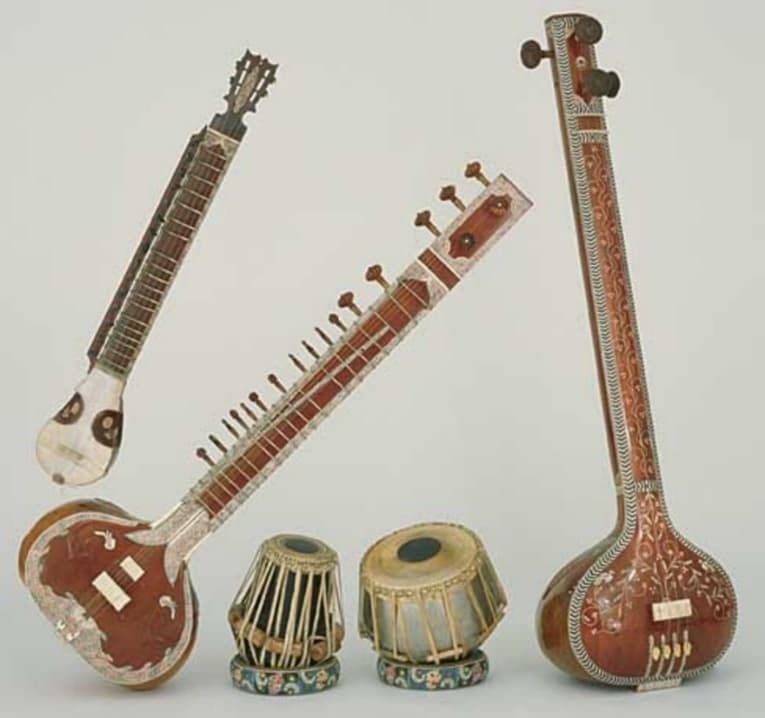
Indian classical instruments: sitar, veena and tabla
Indian classical instruments including sitar, veena and tabla.

Hindustani and Carnatic instruments
(This text has been kindly contributed by Tammo Heikens)

Not only is there a difference in Hindustani and Carnatic music, but also in the instruments that are used by either. Typical Hindustani instruments are the plucked string instruments like the ‘been’ (Rudra veena) sitar, surbahar, sarod and bowed instruments like sarangi, taus, dilruba and esraj. Another type of stringed instrument is the santoor, which uses sticks to play the strings. For wind instruments bansuri and shenai are probably the most common. Prominent Hindustani percussion instruments are the pakhawaj, dholak, kanjira and last but not least the omnipresent tabla. Carnatic string instrument include the Saraswati veena and mandolin. Wind instruments are the murali, venu and nadaswaram, but also the saxophone. Prominent in Carnatic percussion are the mridangam and the ghattam (claypot) Some instruments that are used in both Hindustani and Carnatic are interestingly from western origin, like the violin, the harmonium and several variations of guitars. Also tanpura is used in both styles of music albeit with a different construction. Hindustani stringed instruments often use a gourd (pumpkin) as a soundbox, whereas in Carnatic music similar instruments (e.g. tanpura) are made of solid wood. The harmonium is a small type of hand pumped organ, that was introduced by French missionaries to India and became so widespread that it is now by many considered to be an Indian instrument (which it is not obviously). It became so popular that it would be difficult to find a house in India without a harmonium and has largely taken over the traditional role of the sarangi as an accompanying instrument for vocalists. Many purists however still consider harmoniums unfit for Indian music, because it cannot produce slides from one note to another (‘meend’)

The source of many of the Hindustani instruments can be traced back to Persian instruments that where introduced by Persian court musicians during the Moghul period. Examples are the sitar, which is derived from the sehtar and the santoor which also has a much more ancient counterpart in Persian music. The same holds true for the nature of Hindustani music and explains largely why the Carnatic music is so different from Hindustani. The Carnatic music can be considered a more pure version of the original Indian music of old. Hindustani music on the other hand was the hybrid outcome of the merging of the cultures of India and Persia.
Sacred Expressions

Dhrupad, Qawwali and Sama

Dhrupad

Dhrupad is a genre in Hindustani vocal classical music from the Indian subcontinent. The roots of Dhrupad are ancient. The term denotes both the verse form of the poetry and the style in which it is sung. Hazrat Inayat Khan and his brothers were skilled in this genre of music.

Dhrupad on Wikipedia
Ancient Hindustani vocal tradition

Qawwali

Qawwali is a form of Sufi Islamic devotional singing originating in South Asia. Originally performed at Sufi shrines throughout the Indian subcontinent, it is famous throughout Pakistan, India, Bangladesh and Afghanistan and has also gained mainstream popularity and an international audience as of the late 20th century.

Sama

The term 'Sama' is not referring to musical style or type of composition but to a musical gathering within the Sufi tradition. Sama, literally 'listening', is a Sufi ritual performed as part of the meditation and prayer practice known as Dhikr (Remembrance of God).

The term sama stems from the root-verb meaning 'acceptance by tradition'. It may have been in use since the tenth century to refer to a type of dhikr, a ceremony used by various Sufi orders, particularly the Chishti order of the sub-continent.

It originates from the Sufi mystic Rumi, who is said to have fallen into an ecstatic trance after wandering through a city and hearing the name of God in the rhythmic hammering of a goldbeater. As an imitation of this, Sama invites the practitioner to reflect on the all-encompassing presence of God.

Sama often includes singing, playing instruments, dancing, recitation of poetry and prayers, wearing symbolic attire, and other rituals. Sama is a particularly popular form of worship in Sufism.

Sama in Sufism
Listening as ritual, remembrance and devotion
Historical Ensemble

The Royal Musicians of Hindustan

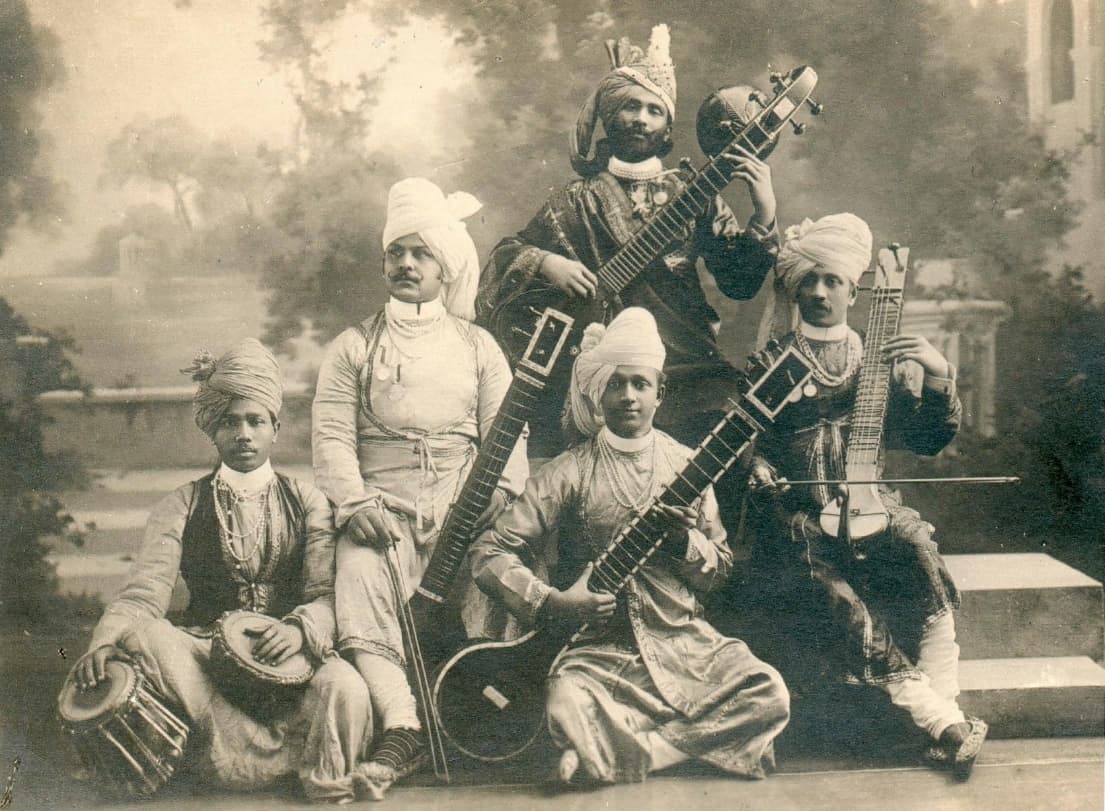
On September 13, 1910, Hazrat Inayat Khan traveled by ship from Bombay, via Naples, to New York, America, with his brother Maheboob and cousin-brother Ali, together with their instruments. His younger brother Musharaff would join the group a year later.

Thus, the group 'The Royal Musicians of Hindustan' was formed, supplemented by the young Hindu tabla player Rama Swami. They performed from 1910 on in America, and on later travels in France, Russia and England. In some cases they were asked to accompany other performers such as singers and dancers, such as Ruth St. Denis and Mata Hari.

The Royal Musicians of Hindustan, circa 1910
From left to right: Rama Swami (tabla), Mohammed Ali Khan (dilruba), Inayat Khan (veena), Musharaff Khan (sitar) and Maheboob Khan (dilruba).
Composition Legacy

The Khan Brothers as Composers

Music of the brothers has been played throughout the twentieth century at gatherings, summer schools and worship services, both live and through archived recordings.

Hazrat Inayat Khan

1882 - 1927

At an early age Inayat Khan was trained in music by his grandfather Moulabakhsh, his father Rahmat Khan and his uncle Murtuza Khan. When he turned eighteen he started working as a professor of the Gayanshala (Music School), founded by his grandfather in Baroda, India. Another uncle, Dr. Pathan, made Inayat familiar with and experienced in western classical music. From a young age he traveled extensively, performing his music at royal courts throughout India.
In 1910 he traveled to the West and promoted Indian music and mysticism, accompanied by his brothers, as the 'Royal Musicians of Hindustan'.
For his Western followers one of the key contributions was the composition of his 'Singing Zikar', based on an Indian Raga. Through his music and teachings, he introduced the Eastern sacred tradition of Sufism to Western audiences.

Maheboob Khan

1887 - 1948

Shaikh-ul-Mashaik Mir Pyarumian Maheboob khan was the five-year younger brother of Hazrat Inayat khan, the poet-philosopher and scholarly musician and mystic.
The brothers were close and united in their musical genius and mystical inwardness.
Maheboob had an exceptional beauty of voice as judged by both Hazrat and later western specialists. He succeeded Hazrat in his professorate at the Baroda Gayanshala Academy of Music.
Maheboob khan’s greatest abiding contribution to Hazrat’s Indian Sufism in the West are his compositions for voice and piano accompaniment. A large number of the compositions contained Indian melodies from their Barodan Gayanshala and Maulabakhshi repertoires.
Maheboob also created compositions to a number of Hazrat Inayat khan’s English poems were most valued in the Sufi meetings where those were performed. Being averse to commercialization of a to him sacred art, only a few songs were published during his lifetime. The beauty of his music remains profoundly striking. (Source: Shaikh-ul-Mashaik Maheboob khan - Sufimuse)

Mohammed Ali Khan

1881 - 1958

Like his brothers, Murshid Ali Khan, was trained in Indian classical music from childhood. In Europe he recieved additional training in the Western opera repertoire. He developed a beautiful tenor voice and performed on various stages in many music halls during the twenties and thirties.
He composed a piano melody that would accompany the cherags when entering the halls for the perfomance of the Universal Worship, a key celebration within the Western Sufi communities.
During Summer Schools in Suresnes and later in The Hague he often sang the poems of Inayat Khan set to music by Maheboob Khan. On these occasions he would be accompanied on the piano by Halima Lange, a Dutch mureed.
Recordings of his performances have been saved and digitized by Alim Vosteen and are shared on the latters website: www.sufilab.com

Musharaff Khan

1895 - 1967

The youngest of the brothers was a skilled vocalist and sitar player. When Mushid Inayat Khan was no longer able to perform his music on a regular basis, due to his busy schedule as leader of the Sufi Movement, he kept touring with his elder brother Mahaboob Khan on stages throughout Europe. The archives in Suresnes and The Hague have many leaflets testifying of their frequent concert tours.

Today

Sufi Music in Contemporary Times

In today's musical gatherings from all Hazrati branches a wide variety of spiritual music is played.

Classical Indian music, as well as Turkish devotional music are often heard being played live at these events, often referred to as sama meetings. On other occasions recorded music is played of the compositions of Hazrat Inayat Khan and his brothers.

In the files of the different public and sometimes private archives we find recordings of them on vinyl, tape and cassette. Most of these recordings have been transferred in more recent years to CDs and even made available as MP3 recordings.

Also western classical and devotional music and even popular or folk music is enjoyed on many occasions organized by the different Sufi-branches.

"Alim Vosteen, (1935) a Dutch mureed from the fifties onward has spent decades recording all sorts of (musical) gatherings in Holland, at his private home in The Hague, the tempel Murad Hassil in Katwijk aan Zee and Anna Paulownastraat 78 The Hague, as well as several other venues. In addition to this he spent many hours digitizing historical recordings, until then only available on vinyl, tape or cassette.

All these recordings can be found on his SufiLab site and his YouTube channel. At the bottom of this page you will find a link to Alim Vosteen's webpage SufiLab. In addition you are also kindly invited to visit Alim's SufiLab YouTube channel, which features many (often live) recordings of classical and contemporary Sufi music from different countries and cultures."

Archive to Gathering

This tradition remains alive through live devotional meetings, private archive transfers and renewed access through contemporary digital formats.

Research and Listening

External Resources

Explore these references for deeper study of Sufi music, Indian classical context and the musical legacy of the Khan family.

Return to Welcome