Hazrat Inayat Khan
Philosophical and Spiritual
Framework
This page contains information on the elements of Hazrat Inayat Khan's philosophy. Below you will find a survey of the editions that have been reviewed so far and the relevant terms of these works that have been included on this page 'Philosophical and Spiritual Framework of Hazrat Inayat Khan'.
In due time I will add more relevant material from other issues. I hope this list will help the reader to more quickly find relevant terms for there own use: an article, a lecture or personal study and deepening.
You will find content from the following editions:
- A Sufi Message of Spiritual Liberty
- The Unity of Religious Ideals
- Moral Culture
- In an Eastern Rose Garden
- The Way of Illumination
- The Inner Life
- The Soul, Whence and Wither
- Philosophy, Psychology and Mysticism
God is regarded from three points of view:
- 1Personality—God is the most high; man is dependent upon Him and is His most obedient servant
- 2Morality—According to the second view, God is the all-merciful and all-good Master of the Day of Judgment, while all evil is from Satan.
- 3Reality—The third is the philosophic view that God is the beginning and end of all, having Himself no beginning nor end.
Two aspects of the Supreme Being
According to Sufi tenets the two aspects of the Supreme Being are termed:
- 1Zat the Knower (in URI: the Self of God, Purusha, Spirit)
- 2Sifat, the Known (in URI: the qualities of God, Prakriti, Matter)
See also: URI Part V, chapter XI The God of Islam.
Five terms for The Ideal Perfection,
- 1'Baqa' called by Sufis,
- 2'Najat' in Islam,
- 3'Nirvana' in Buddhism
- 4'Salvation' in Christianity
- 5'Mukhti' in Hinduism.
This is the highest condition attainable, and all ancient prophets and sages experienced it, and taught it to the world.
There are three ways in man's journey towards God.
- 1The first is the way of ignorance, through which each must travel. (...) Such is the condition of the average person, who spends his life blindly under the influence of his senses (...)
- 2The next way is that of devotion, which is for true lovers.
- 3The third is the way of wisdom, accomplished only by the few. The disciple disregards life's momentary comforts, unties himself from all earthly bondages and turns his eyes toward God (...)
The only Being has manifested Himself through seven different planes of existence, to accomplish His desire of being recognized:Tanzih:
- 1Zat—the unmanifested
- 2Ahadiat—plane of Eternal Consciousness
- 3Wahdat—plane of consciousness
- 4Wahdaniat—plane of abstract ideas
Tashbih:
- 1Arwah—the spiritual plane
- 2Ajsam—the astral plane
- 3Insan—the physical plane
There are, again, seven aspects of manifestation:
- 1Sitara—planetary
- 2Mahtab—lunar
- 3Aftab—solar
- 4Madeniat—mineral kingdom
- 5Nabitat—vegetable kingdom
- 6Haywanat—animal kingdom
- 7Insan—human kingdom
Insan, being the ideal manifestation, recognizes God by the knowledge of his own self. Man reaches this perfection by development through five grades of evolution:
- 1Nasut—material plane
- 2Malakut—mental plane
- 3Jabarut—astral plane
- 4Lahut—spiritual plane
- 5Hahut—plane of consciousness
Each grade of development prepares a person for a higher one, and perfects him in five different grades of humanity:
- 1Adam—the ordinary man
- 2Insan—the wise man
- 3Wali—the holy man
- 4Qutb—the saint
- 5Nabi—the prophet
The five natures corresponding to these five grades are:
- 1Ammara—one who acts under the influence of his senses;
- 2Lawwama—one who repents of his follies;
- 3Mutmainna—one who considers before taking action;
- 4Alima—one who thinks, speaks and acts aright;
- 5Salima—one who sacrifices himself for the benefit of others.
The following is a diagram illustrating the planes of Nuzul and Uruj (evolution and involution):
All planes of existence consist of vibrations, from the finest to the grossest kind; the vibrations of each plane have come from a higher one, and have become grosser. Whoever knows the mystery of vibrations, he indeed knows all things.
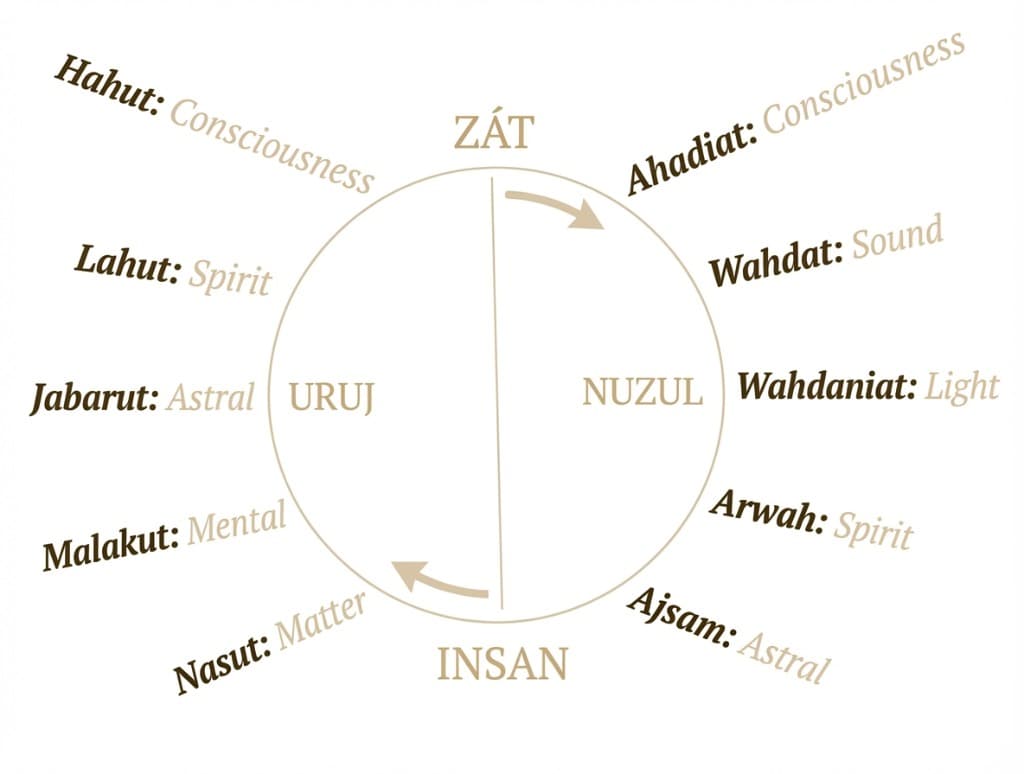
Vibrations are of five different aspects, appearing as the five elements:
- 1Nur—ether
- 2Bad—air
- 3Atish—fire
- 4Ab—water
- 5Khak—earth
In relation to these elements, mankind has five senses:
- 1Basarat—sense of sight the eyes
- 2Samat—sense of hearing the ears
- 3Naghat—sense of smell the nose
- 4Lazzat—sense of taste the tongue
- 5Muss—sense of touch the skin
Through these senses and different organs of the mental and physical existence the Ruh, the soul, experiences life; and when the Ruh receives the highest experience of all phases of existence by the favor of the murshid, then it will have that peace and bliss, the attainment of which is the only object of manifestation.
There are four aspects of the heart:
- 1'Arsh—the exaltation of the will
- 2Kursi—the seat of justice and distinction
- 3Lauh—the fount of inspiration
- 4Qalam—the source of intuition
There are five kinds of dreams:
- 1Khayali—in which the actions and thoughts of the day are reproduced in sleep.
- 2Qalbi—in which the dream is opposite to the real happening.
- 3Naqshi—in which the real meaning is disguised by as symbolic representation which only the wise can understand.
- 4Ruhi—in which the real happening is literally shown.
- 5Ilhami—in which divine messages are given in letters or by an angelic voice.
There are five kinds of inspiration:
- 1Ilhami Ilm—inspiration of an artist and scientist
- 2Ilhami Husn—inspiration of a musician and poet
- 3Ilhami Ishq—inspiration of a devotee
- 4Ilhami Ruh—inspiration of a mystic
- 5Ilhami Ghaib—inspiration of a prophet
Inspirations are reflected upon mankind in five ways:
- 1Kushad dar Khayal—in the wave of thought
- 2Kushad dar Hal—in emotions and feelings
- 3Kushad dar Jamal—in the sufferings of the heart
- 4Kushad dar Jalal—in the flow of wisdom
- 5Kushad dar Kamal—in the divine voice and vision
Music
Music is called Ghiza-i-ruh, the food of the soul, by Sufis. Music being the most divine art elevates the soul to the higher spirit; music itself being unseen soon reaches the unseen; just as only the diamond can break the diamond, so musical vibrations are used to make the physical and mental vibrations inactive, in order that the Sufi may be elevated to the spiritual spheres. Music consists of vibrations which have involved from the top to the bottom, and if they would only be systematically used, they could be evolved from the bottom to the top. Real music is known only to the most gifted ones.
Music has five aspects:
- 1Tarab—music which induces motion of the body (artistic)
- 2Raga—music which appeals to the intellect (scientific)
- 3Qul—music which creates feelings (emotional)
- 4Nida—music heard in vision (inspirational)
- 5Saut—music in the abstract (celestial)
There are five aspects of Wajd (also Wajad, meaning ecstasy):
- 1Wajd of dervishes—which produces a rhythmic motion of the body;
- 2Wajd of idealists—expressed by a thrilling sensation of the body, tears and sighs;
- 3Wajd of devotees—which creates an exalted state in the physical and mental body;
- 4Wajd of saints—which creates perfect calm and peace;
- 5Wajd of prophets—the realization of the highest consciousness called Sidrat ul-Muntaha.
There are seven kinds of concentration in Sufism (left out in Volume V!)
- 1Nimaz—for control over the body
- 2Wazifa—for control over the mind
- 3Zikar—for physical purification
- 4Fikar—for mental purification
- 5Kasab—to enter the Spirit
- 6Shagal—to enter the Abstract
- 7Amal—for complete annihilation
Perfection is reached by the regular practice of concentration, passing through three grades of development:
- 1Fana-fi-Shaikh—annihilation in the astral plane,
- 2Fana-fi-Rasul—annihilation in the spiritual plane
- 3Fana-fi-Allah—annihilation in the abstract.
After passing through these three grades, the highest state is attained of Baqi-bi-Allah, annihilation in the eternal consciousness, which is the destination of all who travel by this path.
Male and female
The only Being is manifested throughout all planes of existence in two aspects, male and female, representing nature's positive and negative forces.
In the plane of consciousness there are two aspects:
- 1Wahdat—consciousness,
- 2Ahadiat—eternal consciousness,
and thus also spirit and matter, night and day, signify the dual aspect on lower planes. In the mineral and vegetable kingdoms sex is in a state of evolution, but the highest manifestation of male and female is man and woman.
There are three kinds of virgins.
- 1One, commonly considered a virgin, who has never had association with a man;
- 2Another is the virgin in heart, whose love is centered in one beloved only;
- 3The third is the virgin in soul, who considers man as God. She alone can give birth to a divine child.
Religion can be seen from five different points of viewPart I Religion
- 1Certain dogmas, laws or teachings
- 2The church and the form of the service
- 3The religious ideal, the Lord and Master of religion, for example Christ
- 4The idea of God
- 5Something living in the soul, the mind and the heart of man
Un. Rel. Id. Part I Religion, Chapter IV
Five deep desires of the soul of man:Part I Religion
- 1Seeking for the ideal
- 2The desire to live
- 3The desire for exaltation
- 4The desire to probe the depth of life (insight)
- 5Happiness and comfort (balance, union, security)
Un. Rel. Id. Part I Religion, Chapter V
Five aspects of prayerPart I Religion
- 1Giving thanks to God for the numberless blessings
- 2Admitting ones shortcomings and asking for forgiveness (showing humility)
- 3To ask for help in the difficulties and troubles in life
- 4The call over the lover to the beloved
- 5To know God and to draw Him nearer
It is these five aspects which constitute the form of religious worship. Un. Rel. Id. Part I Religion, Chapter V
We can see the law (of religion) in five aspectsPart I Religion
- 1The institution of marriage and of divorce (safeguarding the position of women)
- 2The division of (safeguarding) property
- 3The laws on birth and death
- 4The laws of social life
- 5Laws concerning the community and the country
Un. Rel. Id. Part I Religion, Chapter V
Three kinds of people who perform prayingPart I Religion
- 1One who fulfils a certain duty
- 2One who does what he is taught
- 3One with an imagination that he is in the presence of God
Un. Rel. Id. Part I Religion, Chapter VI
Two ways of prayer.Part I Religion
First way has three kinds of prayer:Part I Religion
- 1Thanking God for his gifts
- 2Asking God for his mercy and forgiveness
- 3Asking God to grant the desires and wishes that we have
The second way has two kinds of prayer:Part I Religion
- 1Prayer as an adoration of the immanence of God (for instance in the beauty of nature)
- 2Prayer of an invocation of the Nature of God, of the Truth of His Being.
Un. Rel. Id. Part I Religion, Chapter VII
Two aspects of GodPart II The God-Ideal
- 1God
- 2The God-Ideal (made by men)
Two points of view of the God-IdealPart II The God-Ideal
- 1The point of view of the imaginative person (minor)
- 2The point of view of the God-conscious person (major)
Three steps to spiritual democracy:Part II The God-Ideal
- 1Bowing for a worldly king
- 2Bowing for a priest or a prophet
- 3Bowing for God alone
Step 3 eventually should result in finding the divine spark within oneself which is called self-realisation.
According to the Sufi conception there are seven degrees in the spiritual hierarchy, which can be distinguished as different stages of responsiveness, in other words of higher initiation.Part III The Spiritual Hierarchy
They are:
- 1Pir
- 2Buzurg
- 3Wali
- 4Ghaus
- 5Qutb
- 6Nabi
- 7Rasul
These are the degrees belonging to the inner initiation to which a disciple becomes entitled after receiving the necessary outer initiations. It is beyond words to express what inner initiation means and in what form it is given. Those to whom the inner initiation is unknown may explain it as a dream or as a vision, but in reality it is something higher and greater than that. I can only explain it by saying that the definite changes which take place during one's journey on the spiritual path are initiations, and it is these initiations which include man in the spiritual hierarchy.
An older issue of the Unity of religious Ideals has a different version of this passage. It goes:Part III The Spiritual Hierarchy
- 1According to the Sufi conception there are several degrees distinguished as different stages of responsiveness, in other words of higher initiation. Among them are five principal ones: Wali, Ghaus, Qutb, Nabi, Rasul.
- 2This spiritual hierarchy is mentioned in more lectures and subsequently in different papers.
There are three roads to spiritual attainment, which meet in the end at one junction:Part III The Spiritual Hierarchy
- 1The road of the Master (the path of self-discipline and will-power, more jelal)
- 2The road of the Saint (the path of love, harmony and beauty, more jemal)
- 3The road of the Prophet (the balance between will-power and and resignation to the will of God, more Kemal)
Names of the ProphetsPart IV The Spirit of Guidance
(...) four such distinctions are known:
- 1Abraham was called Habib Allah, the friend of God.
- 2Moses was distinguished as Kalam Allah, the one who communicates with God.
- 3Jesus was called RuhAllah, the spirit of God.
- 4Muhammad was called Rasul Allah, the messenger of God.
There are four duties of the faithful as taught in Islam:Part V Prophets and Religion
- 1Salaat, prayer five times a day
- 2Zakat, charity
- 3Roza, fasting during the month of Ramadan
- 4Hajj, pilgrimage to Mekka
The four grades of knowledge in IslamPart V Prophets and Religion
- 1Sheriat (Sharia)—The law. How to live in the outer world
- 2Tarikat, (Tariqat)—understanding the law
- 3Hakikat , (Haqiqat)—to know the truth of our being and the inner law of Nature
- 4Marefat—the actual realization of God, the One Being, when there is no doubt anywhere.
The Messenger has five aspects to his Being:Part VI, The Message
- 1The Divine
- 2The Ideal
- 3The Prophet
- 4The Message-bearer
- 5The Teacher
(Chapter II The Messenger)
Three stages of action for the followers of the MessagePart VI, The Message
There are three stages of action which the sincere followers of the Message have to pass through:
- 1Receiving the Message (collecting knowledge of the Truth)
- 2Assimilating the Message (pondering, contemplating and practicing)
- 3Representing the Message (sharing)
The Ten Sufi ThoughtsPart VII, The Sufi Movement.
- 1There is one God, the Eternal, the Only Being; none else exists save God.
- 2There is one Master, the Guiding Spirit of all souls, who constantly leads all followers towards the light.
- 3There is one Holy Book, the sacred manuscript of nature, which truly enlightens all readers.
- 4There is one Religion, the unswerving progress in the right direction towards the ideal, which fulfils the life's purpose of every soul.
- 5There is one Law, the law of Reciprocity, which can be observed by a selfless conscience together with a sense of awakened justice.
- 6There is one human Brotherhood, the Brotherhood and Sisterhood which unites the children of earth indiscriminately in the Fatherhood of God.
- 7There is one Moral Principle, the love which springs forth from self-denial, and blooms in deeds of beneficence.
- 8There is one Object of Praise, the beauty which uplifts the heart of its worshipper through all aspects from the seen to the unseen.
- 9There is one Truth, the true knowledge of our being within and without which is the essence of all wisdom.
- 10There is one Path, the annihilation of the false ego in the real, which raises the mortal to immortality and in which resides all perfection.
The Three ObjectivesPart VII, The Sufi Movement.
The International Sufi Movement was founded by Hazrat Inayat Khan with the following objectives:
- 1To realize and spread the knowledge of Unity, the religion of love and wisdom, so that the bias of faiths and beliefs may of itself fall away, the human heart may overflow with love, and all hatred caused by distinctions and differences may be rooted out.
- 2To discover the light and power latent in man, the secret of all religion, the power of mysticism, and the essence of philosophy, without interfering with customs or belief.
- 3To help to bring the world's two opposite poles, East and West, closer together by the interchange of thought and ideals, that the Universal Brotherhood may form of itself, and man may meet with man beyond the narrow national and racial boundaries.
Three directions of world servicePart VII, The Sufi Movement.
- 1The philosophical understanding of life
- 2Bringing about brotherhood among races, nations and creeds
- 3To bring to the world that nature's religion, which has always been the religion of humanity
The structure of this book is built on three laws of behavior:
- 1The law of reciprocity
- 2The law of beneficence
- 3The law of renunciation
We find two tendencies working through different individuals (chapter I, IV):
- 1Recognition of grades (showing gentleness)
- 2Non-recognition of the same (showing spirit)
A Sufi does not believe in one-sided tendencies. He says spirit is wanted and gentleness is needed; both are required on suitable occasions.
Two aspects of existence
When we look at the universe we find there are two aspects of existence: firstly, life; secondly, the condition which compared with what we call life seems to be lifeless. The one aspect of existence we call life, the other aspect we overlook. We divide it into periods and call it time, or we compare it with objects and call it space. We say than an object is alive, when it shows some activity and consciousness, meaning that it can move and see and think. An object that cannot see and is not active, we call dead. Whatever seems to be devoid of activity and consciousness is called a thing. When it has consciousness and activity, it is called living.
The artist needs three faculties:SILENT LIFE
- 1Observation: Observation in itself is a concentration when it is keen and well-focused.
- 2Concentration—Concentration is divided into three aspects:
- 3Expression
Concentration is divided into three aspects:SILENT LIFE
a) designing; b) filling; c) finishing:
- 1Designing: Whatever one is concentrating upon one must first be able to form the outline of. This faculty can be developed by observing and taking in the outline of the object.
- 2Filling: Filling has its two aspects: i) filling with the parts and items that compose the object, however minute; ii) grasping the right sense of the colour. The former comes from the analytical observation and exactness in taking up the object into one's mind. The latter comes by the development of the sense of colour, which is a natural faculty in man.
- 3Finishing: Finishing is again going over the object one has in mind with an examining attitude, and noticing every little detail separately and collectively, and comparing it with the object that the eyes have seen. This requires not only an analytical tendency, but also exactness and development of memory.
There are five different aspects of the art of music:The Supplementary Papers ART AND MUSIC III
- 1popular—hat which induces motion of the body;
- 2technical—that which satisfies the intellect;
- 3artistic—that which has beauty and grace;
- 4appealing—that which pierces the heart;
- 5uplifting—that in which the soul hears the music of the spheres.
Volume II - The Mysticism of Music, Sound and Word, Part I: The Mysticism of Sound, Chapter VII MUSIC (1923)
Note: Compare this to: in A Sufi Message of Spiritual Liberty (1914):
- 1Tarab—music which induces motion of the body (artistic)
- 2Raga—music which appeals to the intellect (scientific)
- 3Qul—music which creates feelings (emotional)
- 4Nida—music heard in vision (inspirational)
- 5Saut—music in the abstract (celestial)
Three aspects of the soul
In the Vedanta the soul is called by three names which denote its three aspects:
- 1Atma is the soul conscious of the life on the surface,
- 2Mahatma is the soul conscious as well of the life within,
- 3Paratma is the consciousness that is the soul of souls, conscious of the Absolute within and without, the God of the knower, the Lord of the seer.
Volume V - Spiritual Liberty, Part III: THE PHENOMENON OF THE SOUL, MANIFESTATION (1)
The ten Sufi thoughts
The ten Sufi thoughts (where this version differs from The Unity of Religious Ideas the words are underlined. The original word(s) is placed between brackets.
- 1There is one God, the Eternal, the Only Being; none else exists save He (God).
- 2There is one Master, the Guiding Spirit of all souls, who constantly leads His (All) followers towards the light.
- 3There is one Holy Book, the sacred manuscript of nature, which truly enlightens the reader (all readers).
- 4There is one Religion, the unswerving progress in the right direction towards the ideal, which fulfils the life's purpose of every soul.
- 5There is one Law, the law of Reciprocity, which can be observed by a selfless conscience together with a sense of awakened justice.
- 6There is one (human) Brotherhood, the human Brotherhood and Sisterhood which unites the children of earth indiscriminately in the Fatherhood of God.
- 7There is one Moral (Principle), the love which springs forth from self-denial, and blooms in deeds of beneficence.
- 8There is one Object of Praise, the beauty which uplifts the heart of its worshippers (worshipper) through all aspects from the seen to the unseen.
- 9There is one Truth, the true knowledge of our being, within and without, which is the essence of all wisdom.
- 10There is one Path, the annihilation of the false ego in the real, which raises the mortal to immortality, (and) in which resides all perfection.
There are two aspects of intelligence:
- 1Intellect—knowledge of names and forms
- 2Wisdom—knowledge which is illuminated by the light within
Some terms concerning consciousness; the wakeful state
- 1Knowledge is that of which the consciousness is conscious
- 2Conscience is the relation between your actions and your ideal
- 3Intelligence is the grasping faculty of consciousness
- 4Ignorance is the state when the mind is in darkness
- 5Imagination are mental vibrations that flow into the astral plane without conscious direction
- 6Thoughts are mental vibrations that flow into the astral plane with conscious direction
- 7Dream is imagination while being asleep
- 8Impression is a feeling which rises as a reaction on receiving a reflection coming from the external world (physical, mental or astral
- 9Intuition is an inner message independent of an external source
- 10Inspiration is a rising stream from the depth of the heart of the Jinns
- 11Vision is a spiritual dream when awake or asleep
- 12Revelation is the disclosing of the inner self
Three inclinations of the pupil before initation (Bayat)Part III The Sufi
- 1The desire to learn something different from what is taught in the world
- 2The feeling that one is already a sufi
- 3The feeling that the Message is genuine
There are three ways in which people trust:Part III The Sufi
- 1Not to trust a person until he proves in time to be trustworthy
- 2To trust and continue to do so until the person is proved to be unworthy of trust
- 3To have absolute trust, the trust of a devotee (it is these mureeds who make the Murshid)
Invalid reasons to want initiation:Part III The Sufi
- 1For the sake of curiosity to see what is going on in a 'secret' order
- 2To gain some material advantage in one's occupation
- 3For the sake of attaining happiness
- 4If one has set before oneself certain principles one does not wish to abandon
Sufis are inclined to recognize four stages of belief:Part III The Sufi
- 1Iman-e Mumil. To believe what others believe
- 2Iman-e Kamil. To believe in the scriptures and the lessons of the savior
- 3Haq al-Iman.To believe because his reason allows him to believe
- 4'Ain al-Iman. To believe from conviction
The breaking of one belief to progress to the next stage is called Tark (abandonment):Part III The Sufi
- 1Abandonment of the worldly ideal
- 2Abandonment of the heavenly ideal
- 3Abandonment of the divine ideal
- 4Abandonment of the abandonment
The inner life consists of two things:Chapter I The preparation for the journey
- 1Action with knowledge
- 2Repose with passivity of mind
By keeping balanced in these two directions one comes to the fullness of life.
The God ideal can be imagined in different ways:Chapter II The object of the journey
- 1God as a Father or Mother
- 2God as a Creator
- 3God as a Judge
- 4God as a Forgiver
- 5God as a Friend
- 6God as the Beloved
The inner journey has also a tendency to go backwards:Chapter II The object of the journey
- 1Aspects of youth: health, vigour, strength, enthusiasm, energy and a living spirit
- 2Aspects of a child: eager to play, ready to laugh, no worry or anxiety
- 3Aspects of an infant: innocence, no regard for honour or insult
- 4Aspects of basic humanity: self-sacrifice, respect, gratitude faithfulness, patience and endurance
- 5Signs of the animal kingdom; the strength and power of an elephant, the inclination of a horse to serve, the cow that lives harmoniously in the world
- 6Signs of the vegetable kingdom: bringing forth fruit and flowers, patiently waiting for the rain
- 7Aspects of the mineral kingdom, to become a rock for people to lean on.
- 8The Jinn quality, all-knowing and all-understanding
- 9The nature of an Angel, to be worshipful
- 10The stage of perfection
In the attainment of the inner life there are five things necessary:Chapter VIII. The attainment of the inner life
- 1The mastery of the mind by the process of unlearning
- 2To seek a spiritual guide
- 3Receiving knowledge of the inner world in three steps:—Receiving the inner knowledge; Assimilating the inner knowledge; Reasoning out the inner knowledge
- 4Meditation (Ryazat)—First doing it mechanically at a certain time during the day; Then continue to think of the object of meditation at some moments during the day; Finally being in a meditative state throughout the day and the night.
- 5The loving of the everyday life. This exercise has five principles:—Avoid hurting the feelings of another; Avoid allowing themselves to be affected by the constantly jarring influences which every soul has to meet in life; Keep ones balance under all different situations and conditions which upset this tranquil state of mind; Love unceasingly all those who deserve love, and to give to the undeserving their forgiveness; Detachment amidst the crowd (Khilwad dar Anjuman)
How does one live an inner live in the world, amidst people of all kind?Chapter X The five different kinds of spiritual souls
- 1The religious character—living the religious life
- 2The philosophical mind—he understands all things of the world inwardly
- 3The server—the one who does good to others
- 4The mystic—an example of God's mystery in the form of man
- 5The Madzub—who puts on the mask of innocence
There is no end to the variety of the outward appearance of spiritual souls in life; but at the same time there is no better way of living in this world and yet living the inner life than being oneself, outwardly and inwardly.
Five Kinds of Spiritual Souls
How does one live an inner life in the world, amidst people of all kind?
- 1The religious character—Living the religious life
- 2The philosophical mind—Understanding all things of the world inwardly
- 3The server—The one who does good to others
- 4The mystic—An example of God's mystery in the form of man
- 5The Madzub—Who puts on the mask of innocence
There is no end to the variety of the outward appearance of spiritual souls in life; but at the same time there is no better way of living in this world and yet living the inner life than being oneself, outwardly and inwardly.
The manifestations of ZatTerm / Sufi Message of Spritual Liberty / The Soul Whence and Wither
The manifestations of Zat are discussed in the introduction in a way that was done before in 'The Sufi Message of Spiritual Liberty' (1914). The explanation has somewhat evolved as is shown below
- 1Zat—the unmanifested
The Truly Existing
- 2Ahadiat—plane of Eternal Consciousness
The Absolute
- 3Wahdat—plane of consciousness
The Consciousness of Existence
- 4Wahdaniat—plane of abstract ideas
Logos, the first Ego. I am.
- 5Arwah—the spiritual plane
The Divine Spirit of the Nur (light)(Light and darkness form a mould, an Akasha or Asman)
- 6Ajsam—the astral plane
The Divine Spirit as form and motion
- 7Insan—the physical plane
The Divine Spirit spreads it's rays as various souls (mineral, vegetable, animal and human
Vibrations are of five different aspects, appearing as the five elements:
(Between brackets is the spelling of 'The Sufi Message of Spiritual Liberty' (1914).
- 1Nur (Nur)—ether
- 2Baad (Bad)—air
- 3Aetsh (Atish)—fire
- 4Aab (Ab)—water
- 5Khaak (Khak)—earth
These five elements are present in all Akasha's.
Creation seen as the breath of God:
- 1Inhalation, contraction, concentration of intelligence
- 2Exhalation, expansion, manifestation, spreading of the Divine Spirit, creation (Hindu term: Chaitanya)
- 3Inhalation, contraction, withdrawal, destruction (Hindu term: Pralaya)
Light has three principal aspects:
- 1the source of all light, intelligence—intelligence in it's original state, the knowing Being, the Only Being, unawakened intelligence; intelligence in it's process of development, the knowledge of Being. Awakened intelligence; the knowing faculty of men, limited intelligence
- 2the perpetual light, the sun
- 3light in the ordinary sense of the word. In our everyday life, the light of a candle
Part I: Philosophy Chapter VI LIGHT
Four aspects of nature
To a mystic the word nature has a wider meaning; according to the mystical point of view nature has four different aspects.
- 1The forest, the desert, hills and dales, mountains and rivers, sunrise and sunset, the moonlit night and the shining stars are one aspect of nature. (...)
- 2And then we come to the next aspect of nature, an aspect which manifests through the lower creation. The silent little creatures crawling on the earth, the birds singing in the trees, the lion with its wrath, the elephant with its grandeur, the horse with its grace, and the deer with its beauty, all these tell him something. (...)
- 3There is an aspect of nature which is still more interesting, and to see it the mystic need not go away, for he sees it in the midst of the world. What is it? It is to read human nature and to watch its continual change, (...)
- 4And the fourth aspect of nature is seeing the divine nature, realizing the meaning of the saying that man proposes and God disposes. When one is able to see the works of God in life, another world is opened before one; (...)
Part III: Mysticism, Chapter VII, NATURE
Four Aspects of Nature
To a mystic the word nature has a wider meaning; according to the mystical point of view nature has four different aspects:
- 1Physical nature—Forest, desert, hills and dales, mountains and rivers, sunrise and sunset, the moonlit night and the shining stars
- 2Lower creation—Silent creatures crawling on earth, birds singing in trees, the lion with its wrath, the elephant with its grandeur
- 3Human nature—Reading human nature and watching its continual change, seen in the midst of the world
- 4Divine nature—Seeing the works of God in life; realizing that man proposes and God disposes
To a mystic the word nature has a wider meaning; according to the mystical point of view nature has four different aspects.